Inside the Work

4 minute read

3 minute read
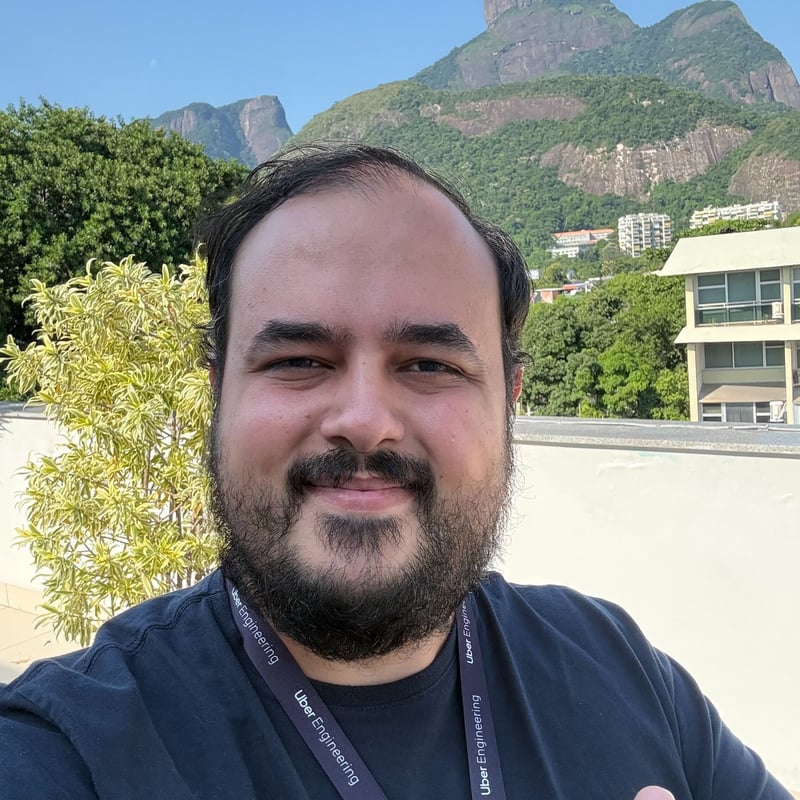
Based in Rio, Pedro is a backend engineer at Uber, building high-scale APIs with end-to-end ownership across experiments and production systems.
“Tech has been my thing since I was a kid building game servers — now, with five years in backend engineering at Uber, I’m building high-scale APIs across fintech and growth. One highlight was shipping an anti-fraud system that saves around $6M a year; I’m big on ownership, and I’m often the go-to for backend and Go. Outside of work, I still ship side projects (including an API that serves billions of requests), and I recharge with anime and electric guitar.”
At Uber, I’m a backend engineer focused on high-scale APIs. I started on the Uber Cash team, working on financial systems and fraud prevention, where I built an anti-fraud system that saved about $6 million annually.
Now I’m on the Riders-to-Eaters (R2E) growth team, focused on increasing Eats adoption. My scope is owning backend services end-to-end:
All while supporting experiments and new product features. Day to day, I spend time:
The main challenge is balancing speed and reliability — moving fast for growth experiments while maintaining stability at scale.
I had a great experience at Uber, and I didn’t leave because of the work or the team. It was mainly a location constraint: I’m based in Rio, and at the time I needed to be in São Paulo.
Now that Uber’s presence in Rio is growing, it felt like the right moment to come back. What excites me isn’t just returning — it’s the opportunity to help shape a new office from an early stage: working closely with leadership, influencing how the team grows, and contributing both technically and culturally.
For me, it’s a combination of continuing to work on problems I care about, while also having a broader impact by helping build something new.
Being part of the Rio founding team means going beyond delivering on my individual scope as an IC. It’s about helping set the technical and cultural foundation for the office.
I see it as an opportunity to raise the bar early by:
At the same time, I expect to work closely with leadership and have more visibility and ownership than I would in a more established office.
Overall, I want to contribute not just as an engineer, but as someone helping shape how the team grows and operates long term.
In FinProd, the most interesting challenges were around correctness and risk at scale. In financial systems and fraud prevention, small mistakes can have significant monetary impact. A big part of the work was designing systems that were both highly reliable and resilient to abuse.
Moving into Delivery and growth-focused products, I expect a different set of challenges. The systems are still large-scale, but the focus shifts more toward iteration speed, experimentation, and user behavior. It’s less about strict correctness and more about optimizing for impact — improving conversion, engagement, and adoption.
One of the biggest lessons I’ve learned at Uber is that in a culturally diverse, distributed organization, alignment becomes more important than control.
Different teams and regions naturally have different communication styles, assumptions, and ways of working. What works is being explicit about goals, context, and expectations — so everyone understands the “why” and can make good decisions independently.
I’ve also learned that simple things like clear communication and strong documentation have an outsized impact at scale. They help bridge cultural gaps and reduce misunderstandings.
For me, the key lesson is: when you create alignment and clarity, teams from very different backgrounds can collaborate effectively without slowing down.
Uber is a great place if you care about real-world, high-scale problems with direct user and business impact.
As a backend engineer, you work on systems that operate at massive scale, where performance and reliability truly matter. There’s also a strong sense of ownership — you’re not just shipping code, you’re responsible for the full lifecycle and the outcomes.
Another thing I’d highlight is the variety of problem spaces. You can work on fintech, fraud, logistics, growth, and more — all within the same company— which keeps the work interesting and helps you grow quickly.
Overall, if you’re looking to deepen your technical skills while having tangible impact, it’s a very strong environment.